Ceramic Coating vs PPF: Which Do You Actually Need?
Ceramic coating and paint protection film (PPF) are the two most effective ways to protect your car's paint — but they solve different problems. The question we hear most at our Bolton workshop is simple: "which one do I actually need?" The honest answer depends on how you use your car, where you drive, and what you're trying to protect against. This guide gives you real scenarios so you can make an informed decision.
What Each Product Is Designed To Do
Ceramic coatingbonds chemically with your car's clear coat to create a hardened, hydrophobic surface. It excels at UV protection, chemical resistance (bird droppings, industrial fallout, road film), and making the car dramatically easier to clean. Ceramic Pro 9H — the professional product we use at Latin King Detailing — sits at 9H pencil hardness, the maximum measurable. It does not absorb physical impacts.
Paint protection film (PPF) is a polyurethane film physically laminated to the paint surface. KAVACA PPF is self-healing — light scratches and swirl marks disappear with heat. More importantly, PPF absorbs stone chips, road debris impacts, and minor abrasions that would otherwise permanently damage the paint underneath. It does what ceramic coating cannot: stop physical damage before it reaches the paint.
Scenario 1 — You Drive Mostly on City Roads and Dual Carriageways
If your main routes are the M60 ring road, the A56, or through Manchester and Salford city centres, stone chips from high-speed motorway driving are not your biggest risk. What you face more is road film, brake dust, bird droppings, and the difficulty of keeping a dark car clean through a Greater Manchester winter.
Recommendation: Ceramic coating. It handles everything urban roads throw at your paint, makes washing fast and effective, and protects against the chemical threats most city drivers encounter daily.
Scenario 2 — You Regularly Use Fast A-Roads, the M6, or the M62
Motorway and fast A-road driving at 60–70 mph significantly increases stone chip risk. Lorries and heavy goods vehicles constantly shed road debris. The front bumper, bonnet leading edge, and A-pillars take the most punishment. Even a short regular commute on the M62 between Manchester and Leeds generates significant chip risk over months.
Recommendation: PPF on high-impact zones (full bonnet, bumper, mirrors, door edges) plus ceramic coating over the top. This is the combination most of our customers choose for daily-driven prestige vehicles. The PPF absorbs chips; the ceramic coating goes over the PPF and the rest of the car to give a unified hydrophobic finish and simplified maintenance.
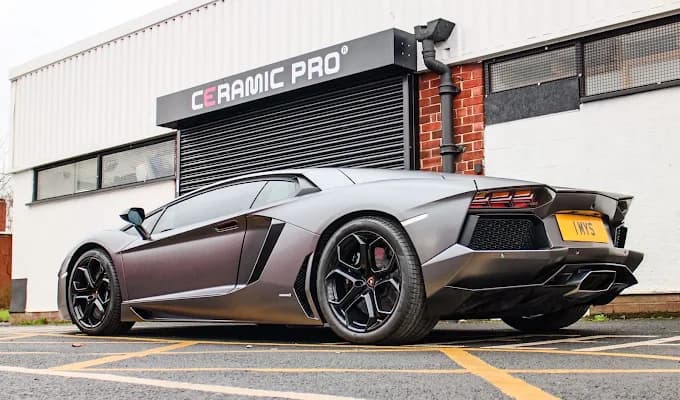
Lamborghini Aventador — full PPF and ceramic coating, Bolton workshop.
Scenario 3 — You Have a New or Nearly-New Prestige Car
Porsche, BMW M-Series, Range Rover, Audi RS, Mercedes AMG — these vehicles come from the factory with paint that looks stunning but is often softer than equivalent paint on older cars. Many modern eco-friendly waterborne paints scratch and chip more easily. A new £60,000–£100,000 car losing paint condition quickly is an expensive problem.
Recommendation: Full-front or full-car PPF applied immediately, ideally within the first week of ownership before any damage occurs, with ceramic coating over the full vehicle. This protects the car's value, preserves the factory finish, and ensures any future paint correction is minimal. Many of our Manchester and Altrincham customers bring new cars directly from the dealership.
Scenario 4 — Budget Is a Factor
PPF is more expensive than ceramic coating — full-car PPF on a large vehicle is a significant investment. If budget is a constraint, the priority order is:
- Ceramic coating on the full car — excellent all-round value, protects against most everyday threats
- PPF on front bumper and bonnet only — targets the highest chip-risk areas within a tighter budget
- Full front-end PPF (bumper, full bonnet, wings, mirrors) — the most popular middle-ground package
- Full-car PPF — maximum protection, best for high-value vehicles or long-term ownership plans
Ceramic coating alone is never the wrong choice — it's a meaningful upgrade from an unprotected paint finish at a price point accessible to most car owners. You can always add PPF to specific zones later.
Can You Have Both?
Yes — and this is what we recommend for most prestige vehicles. KAVACA PPF is applied first to the high-impact panels; Ceramic Pro 9H is then applied over the PPF and across the rest of the car. The result is a unified, hydrophobic surface with physical impact protection in the most vulnerable areas and chemical/UV protection everywhere else.
If you're not sure which combination makes sense for your car, call or WhatsApp us. We'll look at your vehicle, your typical driving routes, and give you an honest recommendation — not just the most expensive package.
Latin King Detailing
Bolton's certified Ceramic Pro installer and car detailing specialists. Based in Farnworth, serving Greater Manchester. Learn more about us.